Is Leonardo da Vinci really buried here?
What actually happened
Leonardo died at the Clos Lucé, five hundred metres up my street, on 2 May 1519. His will asked for burial in the collegiate church of Saint-Florentin, which stood inside the château walls. He was buried there, and for two and a half centuries that was the end of it.
Then the Wars of Religion damaged the church, the Revolution finished the job, and in the early nineteenth century the whole structure was pulled down along with most of the château — the demolition described on the history page. The graves went with it. Bones from several burials ended up mixed in the rubble of the site.
The 1863 identification
In 1863 the writer Arsène Houssaye dug in that rubble and came out with a skeleton he declared to be Leonardo’s. His reasoning: the size of the skull, the position of the remains relative to where the church had stood, and some stone fragments bearing letters he read as parts of the name “LEO DUS VINC”. That is the whole of it. There was no comparison with a known relative, no dating, nothing that would count as evidence in a modern laboratory.
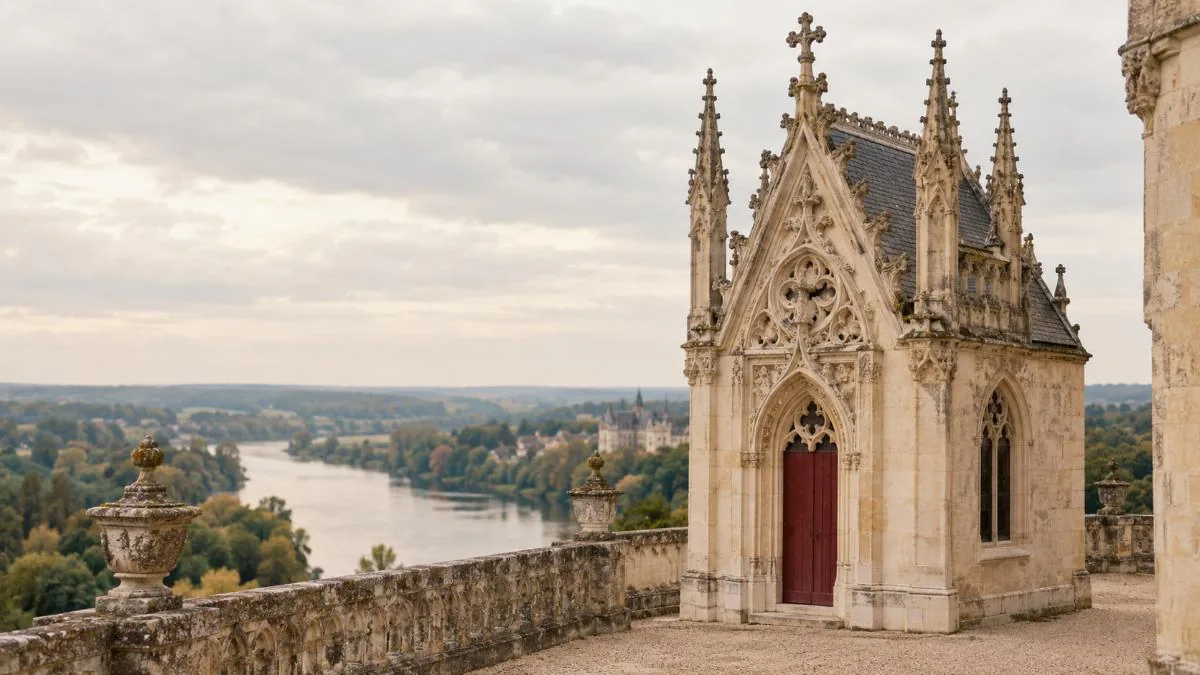
The remains were placed in the Saint-Hubert chapel in 1874, and the memorial slab you see now was recut in 1930. The chapel itself is on its own page.
Why nobody has tested them
The obvious modern move would be DNA. Researchers have worked for years on tracing living descendants of Leonardo’s half-brothers, and a comparison would settle the matter in an afternoon. The bones have not been opened for it. The château is privately owned — see who owns the château — and a negative result would unmake one of the most visited graves in France. I do not think anyone is in a hurry.
What I tell people at the slab
That this is a memorial and probably a grave, that the probably is genuine, and that standing at it is still the closest you will get to the man — he really did die a few hundred metres away, in a house you can walk to in eight minutes, described on the Clos Lucé page. The uncertainty does not spoil it. It just makes the sign a little too confident.
Read the slab carefully. It says the remains were presumed to be his when they were gathered — the château has never actually claimed certainty. The certainty is in the guidebooks, not on the stone.
What there is to book
Not the entrance ticket — that is bought at the château’s own desk when you arrive. What is bookable is the guiding, and the day trips that include entry to Amboise along with the other Loire châteaux.
Frequently asked questions
So is he in there or not?
Probably. The remains came from the right church on the right site, but the identification is a nineteenth-century judgement, not a test.
Has DNA testing been done?
No. Genealogical work on his family line exists, but the Amboise remains have not been sampled.
Is it worth visiting the tomb anyway?
Yes. It is a small, quiet, genuinely beautiful chapel, and he did die five hundred metres away.